
From the discoveries of brain research about why we react the way we do, we can draw many lessons about what supports a change and what creates unnecessary resistance.
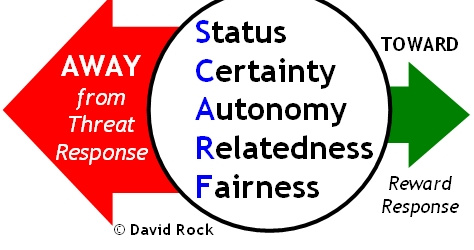
The SCARF model summarises five social domains that studies have shown activate the same threat and reward systems as physical threats and real rewards:
- Status — relative importance to others
- Certainty — being able to predict the future
- Autonomy — a sense of control over events
- Relatedness — a sense of safety with others
- Fairness — a perception of fair exchanges between people
When we experience social threats, the brain reacts in the same way as when there is a lack of basic needs such as food or safety. The brain’s analytical and creative systems shut down — an important insight for anyone leading change.
Status
Creates resistance: Ignoring those who lose their jobs, their position or their ability to influence.
Increases engagement: Notice when people develop. Give plenty of positive feedback.
Certainty
Creates resistance: Painting threatening pictures and then leaving employees without information for a long time. Creating uncertainty about what is expected of them.
Increases engagement: Clarify the project’s purpose, target picture and boundaries. Break the complexity down into manageable sub-projects. Keep everyone informed about when more information is coming.
Autonomy
Creates resistance: Forcing the change through. Implementing big changes quickly and without warning. Micromanaging managers and employees.
Increases engagement: Involve the organisation early. Let engaged working groups work on different parts of the project. Let people organise their own workflows within given boundaries.
Relatedness
Creates resistance: Pushing hard even when employees lack trust in management. Carrying out big reorganisations without regard for employees’ social security.
Increases engagement: Find ways to strengthen safe connections between people. The more trust, the better the collaboration and information-sharing.
Fairness
Creates resistance: Having different rules for different groups — for example, management talking about cuts but exempting themselves, or the organisation talking about values but not living by them.
Increases engagement: Let working groups set their own rules. Establish clear expectations in all situations — from short meetings to longer projects.