
A lecture from Förändringsledningsdagen (the Change Management Day) 2023. For those of you who want a vivid description of how to choose an approach and focus when starting a change effort, with concrete tips and recommendations along the way. The lecture covers the models Prosci’s ADKAR, John P. Kotter’s 8 steps for change, and Six strategies from “How to have influence”. (The lecture is in Swedish.)
Choose
I have read about and used many different change management models, but nowhere have I found guidance on which model fits best for a particular type of change project.
I don’t believe there is a single right answer for how a particular change effort ought to be set up, but here I nevertheless dare to formulate my recommendation, based on my own and my colleagues’ experiences of successful change.
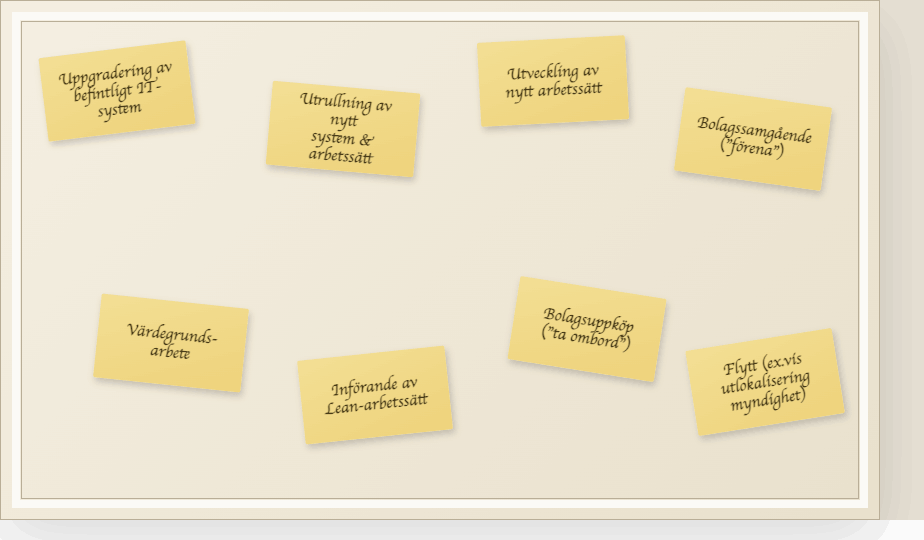
Over nearly two decades of working with change management, I have searched for a simple tool to determine which approach fits best in a given project. The map I have landed on is a matrix with two axes. It is not a scientific model — it is a practical orientation tool that helps me ask the right questions early and make better decisions about methodology.
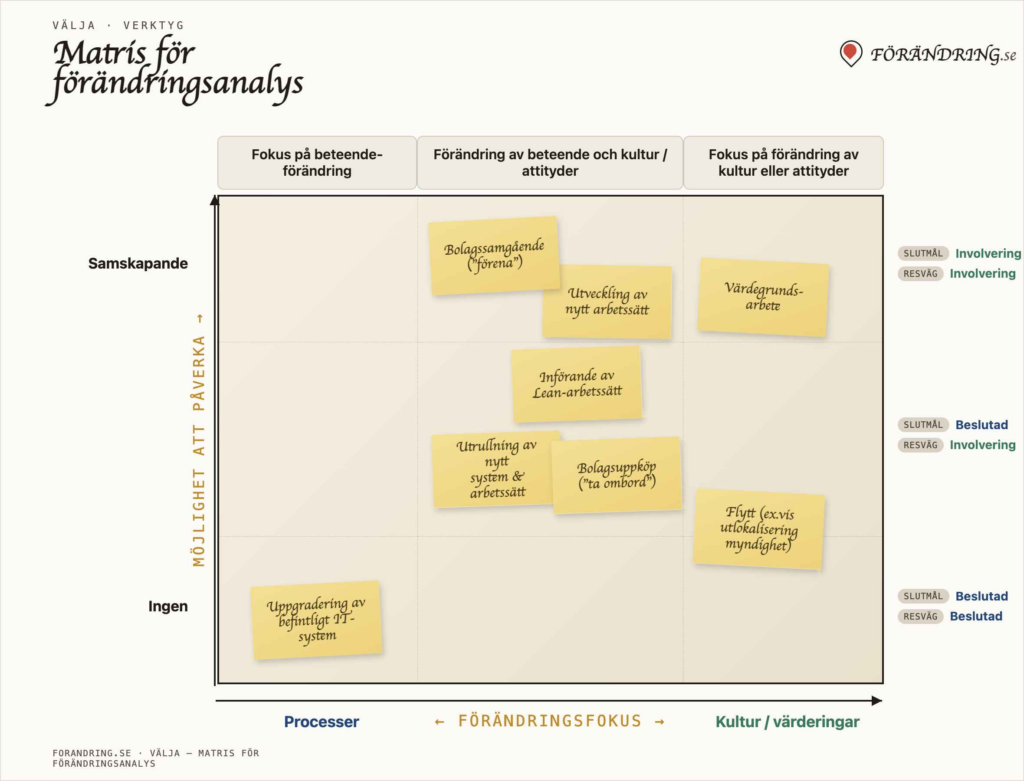
Axis 1 — Sell in, invite in or co-create?
The first axis is about the degree of involvement: how much room there actually is for employees to shape the change.
At one end is what I call “selling in” — the change is essentially already decided and is to be conveyed, explained and pushed through. Management owns the goal. The change work is about creating understanding, handling resistance and ensuring the new is actually used. This is the most common situation in system roll-outs, process standardisations and centrally governed reorganisations.
At the other end is “co-creating” — there is genuine room to shape the direction together with those who will live with the result. The involvement is not cosmetic. It happens before the decisions are made. It creates a sense of ownership that is hard to build after the fact, but it also requires time and an organisation that can cope with not having all the answers ready from the start.
In the middle is “inviting in” — an intermediate position that many projects find themselves in, where the goal may be decided but there is room to influence how we get there.
Determining where a project sits on this axis is often harder than it seems. Involving and engaging managers and employees often creates better solutions and also builds a greater sense of ownership of the final result, and is therefore desirable — but it is just as important to take into account, and be clear about, the degree of influence that managers and employees genuinely have. If most things are already decided, it is better to try to “sell in” the goal and the path to it than to “invite in” involvement when there is nothing left to influence.
Axis 2 — Behaviours or culture?
The second axis is about what is actually to be changed — and how deeply.
“Behaviours” means that employees are to start doing something differently: using a new system, following a new process, applying a new way of working. It is concrete and measurable. It can be trained, instructed and followed up. The change can be demanding, but it is bounded.
“Culture” means that the change reaches deeper — into values, shared assumptions and what the organisation takes for granted. It is what sits in the walls. Cultural change is harder to plan and measure, takes longer and requires a persistent leadership commitment that is easily underestimated in the project plan.
Most projects move along a continuum between these poles, and there is no shame in being in the middle. But being clear about where the centre of gravity actually lies — behaviour or culture, or both — affects the choice of model, the time horizon and which actors need to be on board from the start.
The different segments
The two axes create different segments, each of which requires a somewhat different approach. Which model I recommend for each segment — and why — I describe in the next section.
Here is a walk-through for those of you who want to dive into a few different change management methods and make a well-grounded choice of approach. I cover the following models:
- Prosci’s ADKAR
- John P. Kotter’s 8 steps for change
- INDEA’s 8 steps for involving change
- Six strategies from “How to have influence”
- The Four Rooms of Change
- A model for strengthening implementation capability from “Silent killers”.
These are my highly personal preferences (and recommendations) for which type of change management model suits which type of change work!
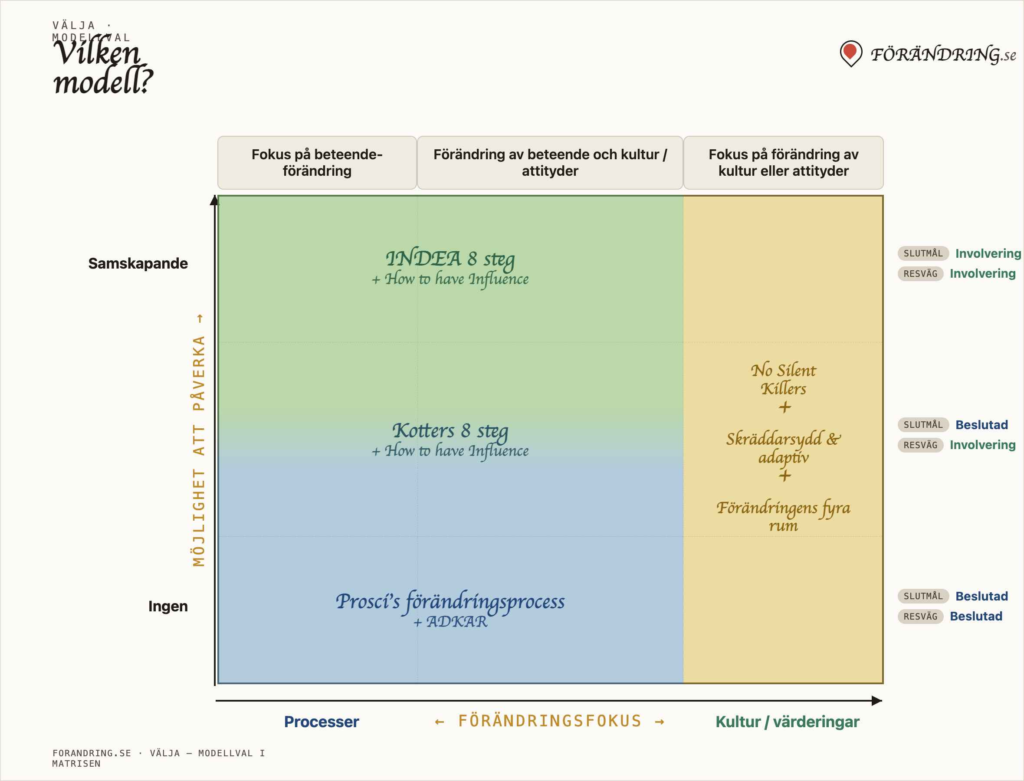
Co-create + Behaviours/attitudes → INDEA’s 8 steps + Six implementation strategies
When involvement is high and the change concerns shared identity, core values or the merger of organisations, INDEA’s 8 steps is my clearest recommendation. The model is built to create genuine ownership — not to sell in a message, but to chisel out the new together. Six implementation strategies works well as a tool in the execution step.
Invite in + Behaviours/attitudes → Kotter + Six implementation strategies
Kotter’s 8 steps is versatile and contains a clear measure of involvement. Combined with the six strategies from “How to have Influence” as a checklist in the implementation step, the model covers the full span from strong management control to active employee engagement. It is the combination I return to most often.
Sell in + Behaviours/attitudes → Prosci + ADKAR
Prosci’s methodology is built for exactly this: structured analysis, a clear implementation plan, and ADKAR as a checklist for the individual journey — Awareness, Desire, Knowledge, Ability, Reinforcement. It is an excellent fit for system roll-outs and centrally governed process changes. With the right adaptation it also works when the degree of involvement is somewhat higher.
All forms of cultural change (deep anchoring) → Strategies against silent killers + Tailored methodology + The Four Rooms of Change
To succeed with cultural change, you usually need to start by strengthening the organisation’s ability to actually carry out and hold on to change. The MIT article “Silent killers for Strategy Implementation and Learning” describes the systematic obstacles that otherwise cause change work to run into the sand (even though everyone seems to agree on the direction), together with powerful strategies against these “silent killers”.
Beyond this, a tailored methodology for involvement and anchoring is needed. It must involve management, managers and all employees both in making concrete how the culture should be expressed in everyday work and which behaviours you want to reinforce or extinguish, but also in how all leaders and groups should develop their working methods, attitudes and collaboration in order to strengthen the desired culture.
Finally, Claes Janssen’s model The Four Rooms of Change can sometimes complement the overall methodology, where various exercises and dialogues can give each group room to identify where they are on their change journey and what they need in order to move forward.
INDEA’s 8 steps + Six implementation strategies
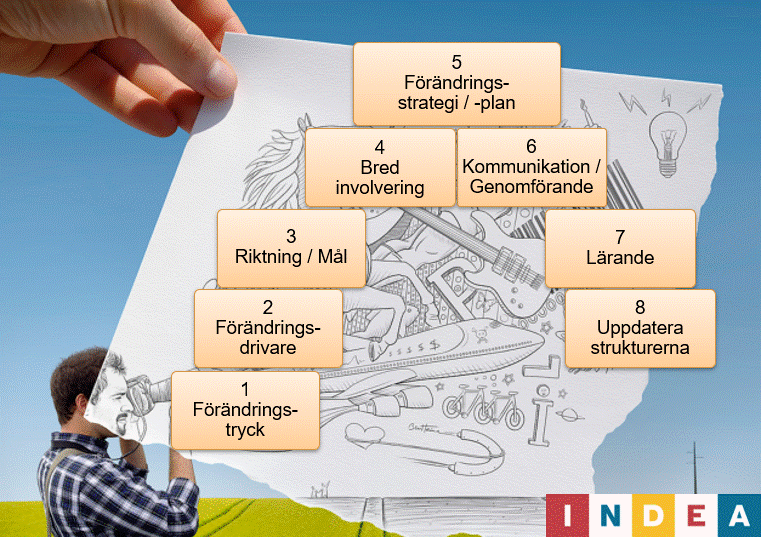
INDEA’s 8 steps is an educational model for change with a high degree of involvement — for cases where anchoring among managers and employees is not just desirable but necessary for the new to become lasting. When merging organisations or departments that need to find a new shared identity, direction and ways of working, it is a model that creates a genuine sense of ownership that is hard to achieve in other ways.
The six-strategy model from the Sloan Management Review article “How to have Influence” serves as a checklist in the implementation step — to ensure that all the necessary components are in place for managers and employees to enter the new together.
INDEA’s 8 steps is a good fit when involvement, shared processing and anchoring among all managers and employees is important and is allowed to take time — for example when merging organisations.
INDEA’s 8 steps is a poor fit when the opportunity to influence is small — in system roll-outs where the ways of working are already given, or when there is no time for genuine involvement. For rationalisation projects there are more suitable alternatives.
A deeper walk-through of INDEA’s 8 steps can be found under the Plan menu
A deeper walk-through of the Six implementation strategies can be found here
Kotter’s 8 steps + Six implementation strategies
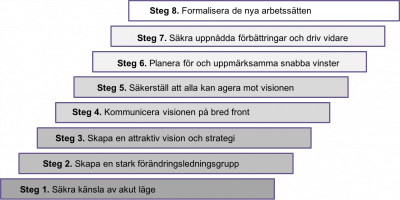
Kotter’s 8 steps structures a change effort with a focus on building strong leadership power before implementation happens. During implementation, you work actively to convey the reasons for the change and the overarching vision — and methodically remove the obstacles in the way.
The model includes a certain measure of involvement but is still built on the goal of the change being set. That makes it versatile — it works both when co-creation is possible and when the change work is more about selling in. The six-strategy model is a suitable tool in the implementation step.
Kotter’s 8 steps is a good fit for both business development and the roll-out of centrally governed processes.
Kotter’s 8 steps is not suitable for rationalisation projects — cuts often stir up such strong emotions that the implementation work needs to be prepared in a different way.
A deeper walk-through of Kotter’s 8 steps can be found under the Plan menu
A deeper walk-through of the Six implementation strategies can be found here
Prosci’s change methodology + ADKAR
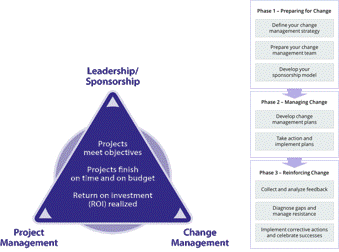
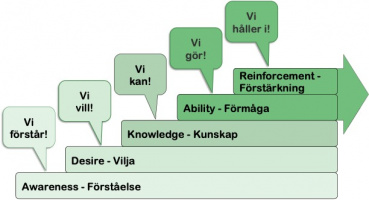
Prosci’s methodology has been developed and refined through decades of research. It contains an analysis and planning phase where the change is mapped from the strategic level down to the individual level — followed by an implementation plan built on strong sponsorship and leadership, clear communication, active coaching and structured handling of resistance.
The ADKAR model governs the pace of implementation: the individual needs to understand the reason for the change (Awareness), want to change (Desire), gain the right competence (Knowledge), start applying the new in everyday work (Ability) and keep it up with the support of feedback (Reinforcement).
The Prosci methodology is a good fit when the path from the current state to the desired state is predictable and plannable. It suits centrally decided system roll-outs and process changes, where much is given and the change work is more about selling in, but it can also be tailored for rationalisation projects.
The Four Rooms of Change
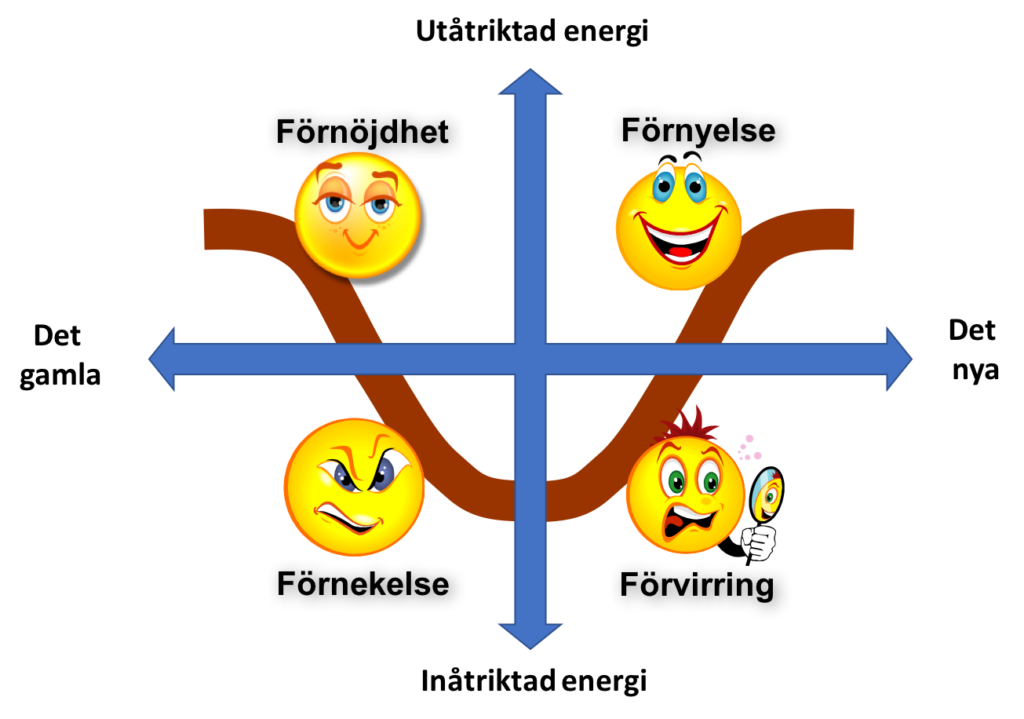
Claes Janssen’s model is built on leading a process over time, where the group themselves identify where they are in the change and develop measures to move forward. The involvement is high and the feeling of being seen in the process is often strong.
An INDEA colleague used the model with great success for an organisation that was to relocate its entire head office to another city — a change that affected everyone’s families and private lives in a profound way. When the change genuinely touches something fundamental in people’s lives, it is a good working tool.
However, the model is resource-intensive and hard to scale in large organisations. In most change assignments there are therefore more resource-efficient alternatives.
A deeper walk-through of The Four Rooms of Change can be found here
Strategies against “Silent killers”
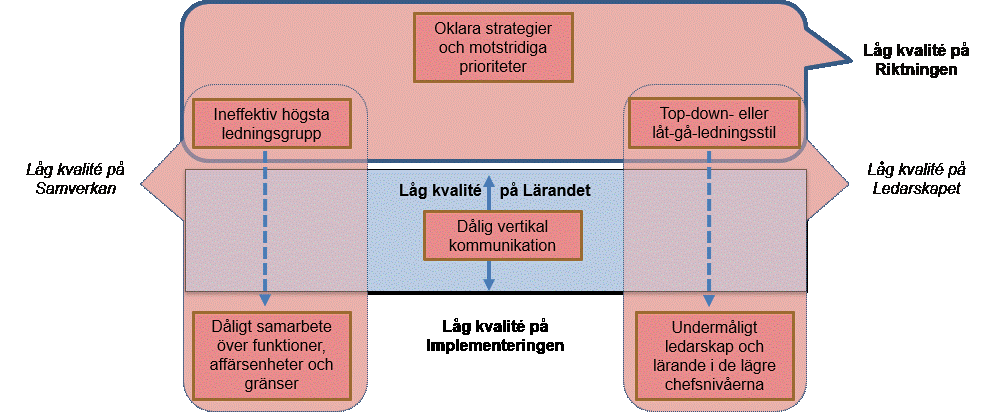
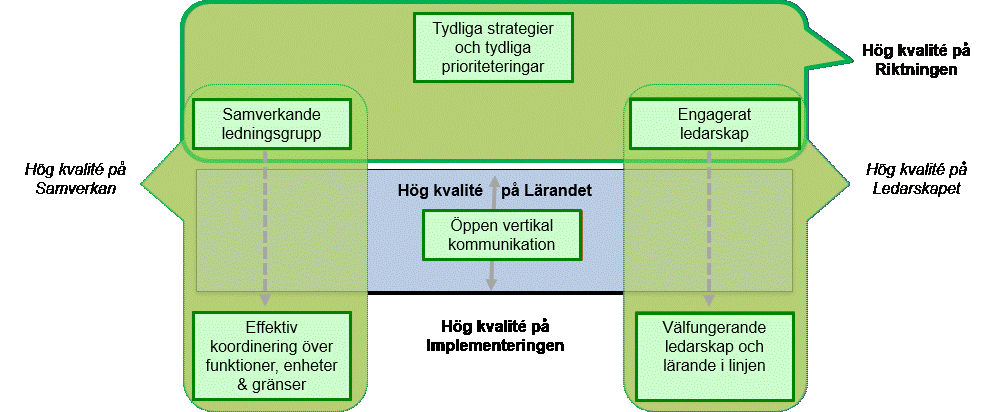
This is not an alternative change model — it is a complement to all of the above.
The MIT article “Silent killers for Strategy Implementation and Learning” describes the systematic patterns that cause change work to run into the sand, even though everyone seems to agree on the direction — projects that start well and meet little resistance, but where nothing sticks. The strategies against silent killers address precisely this: what needs to be strengthened in the organisation’s ability to actually carry out and hold on to change.
Particularly in projects about developing an organisation’s culture, I see it as critical to bring up and work actively on strengthening the organisation’s ability to succeed with implementation. Cultural shift is largely built on extensive feedback on everyday behaviour, at all levels and across all units — which requires clear focus, alignment, engagement and collaboration throughout the organisation.