tema 01 4 fördjupningar

Resistance

Change in an organisation often provokes resistance — even when there are important or compelling reasons to change.

Why are we humans wired this way? Is it possible to understand the resistance, and thereby find keys to overcome it?

I have found that better understanding of the psychology of resistance — and what happens to us as humans during change — makes it easier to launch change projects more sucessfully, makes it easier to handle the reactions that arise, and to work with involvement in a way that helps both the change project and creates a greater degree of engagement in the organisation.

There’s no end to reading material about resistance and reactions to change, both from the change field and from psychology and brain research. Below you will find a selection of summary of different theories and explanatory models that I myself have found to be useful in my change projects and change development programmes for change leaders and managers.


I don’t understand why the change isn’t moving faster!
Everyone knows that if we don’t develop, we’ll go under!
Shouldn’t that be reason enough to change?!”

On hard-headed resistance to change, even when death looms. And on unexpected change when other motivators are put to work.

In the Fast Company article “Change or Die”, Alan Deutschman explores the will and the resistance to change — when your own life is at stake.

Would you make major changes to your lifestyle if it were a matter of life or death? You think you would? Think again — you are probably fooling yourself.

Around 600,000 Americans undergo bypass surgery every year. They are told that the operation will not extend their lives — and that they run a high risk of dying early if they do not change their lifestyle. Truly a matter of changing or dying.

Yet only 10% had changed their lifestyle two years later.

Threats — even the threat of death — are not a strong enough motivator for change.


But there was someone who found a better way.

Dr Dean Ornish at the University of California approached lifestyle change from a completely different angle. Instead of motivating through “fear of dying”, he inspired a new vision based on “the joy of living” — feeling better, not just living longer.

He also discovered that it is often easier to succeed with radical change than with small, incremental ones:

“People who make moderate changes to their diet get the worst of both worlds: they feel deprived and hungry, but the changes aren’t big enough for them to experience a better quality of life.”
— Dr Dean Ornish

333 patients with severely clogged arteries went through Dr Ornish’s programme: quit smoking, a strict diet, support groups, meditation, yoga and aerobics — over the course of one year.

The programme lasted only one year — but three years later 77% of the patients had maintained their new lifestyle and had managed to avoid bypass surgery altogether.

What was the secret? The heart patients experienced rapid and dramatic effects. Before the programme they had suffered so much chest pain that they sometimes could not even cross the street without intense pain. But already in the first month they could report a 91% reduction in chest pain — and suddenly they could enjoy the things that make daily life worthwhile, such as making love and taking long walks without being held back by pain.

“The rapid improvements were a powerful motivator. Joy is also a more powerful motivator than fear.”
— Dr Dean Ornish


“If the manager triggers threat signals, the employees simply cannot deliver. They have only one thing in focus — the tiger that is attacking them. They go into a state of stress and get tunnel vision.”
— Marie Ryd, science journalist and former researcher at Karolinska Institutet

The latest brain research is teaching us more about how we humans react. Within NeuroLeadership, knowledge from neuroscience is applied to the field of leadership — offering new explanations for people’s resistance to change.

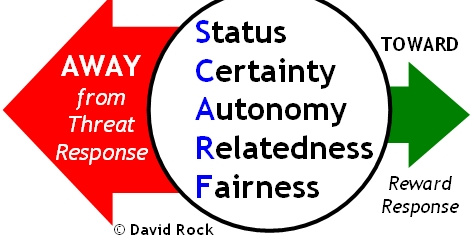
David Rock, an authority within NeuroLeadership, has published the article “SCARF: a brain-based model for collaborating with and influencing others”, which presents new explanations for why change so often provokes resistance.

When we experience social threats, the brain reacts in the same way as when it experiences a lack of basic needs such as food, water or safety. When the brain enters threat mode, we find it hard to concentrate on anything else. The brain’s analytical and creative systems simply shut down — an important insight for anyone leading change.

The SCARF model is built around five domains that neuroscience has shown can activate the same reward and threat systems as real rewards and physical threats:

  • Status – relative importance to others
  • Certainty – being able to predict the future
  • Autonomy – a sense of control over events
  • Relatedness – a sense of safety with others, that they are friends rather than foes
  • Fairness – a perception of fair exchanges between people

1. Status

Status is about relative importance, “pecking order” and hierarchies. We experience status in relation to others, which affects our mental processes in many ways. Our self-perceived status rises when we feel “better than” another person — which activates the brain’s reward circuits. One study showed that an increase in status had the same effect as an unexpected financial windfall. Winning a swimming race, a card game or an argument feels good, probably because the win is linked to a sense of increased status.

Watching out for the feeling of threatened status

At the same time, a sense of diminished status can generate a powerful threat response. Studies have shown that lowered status — for example by being excluded from an activity — activates the same areas of the brain as physical pain.

It can be surprisingly easy to unintentionally threaten someone’s sense of status. Such a threat can arise from a hint of inefficiency, but also from advice or instructions that are perceived as unwarranted. For many people the question “may I give you some feedback?” can evoke the same feelings as hearing rapid footsteps behind them at night.

In change projects where individuals may experience reduced status — for example by losing their place on the management team, having less opportunity to influence, or diminished professional standing — you can expect more resistance. As a change leader you should take this risk seriously and act in a way that reduces the sense of status threat.

2. Certainty

The brain is a pattern-recognition machine that is constantly trying to predict what will happen next. It always wants to know exactly what is going on, because certainty makes prediction possible. Without predictability, the brain is forced to use far more resources to process each moment.

Watching out for the feeling of reduced certainty

The slightest uncertainty generates an error response in the orbital cortex, which forces attention away from the original focus towards whatever is perceived as wrong. It is like the blinking printer icon when the paper has jammed — until it is resolved, it is hard to focus on anything else.

When we feel that someone is not telling the whole truth or is acting inconsistently, it creates uncertainty that can trigger this error response. Greater uncertainty — such as not knowing what is expected of you, or whether your job is at risk — can trigger a far more powerful reaction.

Change management is to a large extent about increasing precisely this sense of certainty, in contexts where uncertainty is high.

3. Autonomy

Autonomy is about independence and choice — the perception that you have control over your own situation. Experiencing greater autonomy is rewarding. Many studies show a strong link between a sense of control and well-being. Research has shown, among other things, that the degree of autonomy affects how people handle stress — unavoidable or uncontrollable stress can be extremely destructive, while the same stress experienced as a choice becomes considerably less destructive.

Watching out for the feeling of reduced autonomy

Working in a group automatically means less autonomy. In well-functioning groups this potential threat can be counterbalanced by increased status, certainty and relatedness — but because the threat to autonomy is always lurking just beneath the surface, it is a risk factor to stay alert to.

A restriction of your autonomy — for example when you experience a lack of control or feel micromanaged — can trigger a powerful threat response. Changes that are announced from above, or the statement “Do this — now”, can therefore trigger powerful threat responses. People may leave successful careers for considerably lower-paid jobs precisely because they value greater autonomy.

4. Relatedness

Relatedness is about determining whether others belong to the social group or not — whether someone is a friend or a foe. It is natural for humans to form “tribes” in which we experience a sense of belonging. The need to include and exclude from the group is probably a natural consequence of the fact that for millions of years we lived in small communities, where strangers were associated with trouble and best avoided.

Determining whether someone is a friend or a foe happens quickly and affects how the brain functions. Information from people we perceive as “like us” is processed by the same circuits we use for our own thoughts, while we use other circuits for someone perceived as an enemy. When someone is perceived as a competitor, our ability to feel empathy also decreases significantly.

Watching out for the feeling of threatened relatedness

The neuroscientist John Cacioppo speaks of the need for safe human contact as a primary drive, much like the need for food. Positive social connections are a primary need — at the same time, a sense of threat is part of our automatic reaction to new social contacts.

In the absence of safe social interaction, a threat response is awakened in the body — the feeling of loneliness. Even meeting a stranger tends to evoke an automatic threat response, and when someone does something untrustworthy, the most common reaction is to withdraw.

Increasing globalisation highlights the importance of managing the threats that come from a lack of relatedness. Collaboration between people from different cultures, who are unlikely to meet in person, can be particularly challenging — the automatic resistance response persists because you do not spend time together.

5. Fairness

Studies show that fair exchanges carry an inherent sense of reward, independent of other factors. Unfair exchanges, in turn, generate a powerful threat response — and can activate the insular lobe, the part of the brain involved in strong emotional expressions such as disgust. People can be driven as far as to sacrifice their lives in order to right perceived injustices.

Watching out for the feeling of unfairness

People who perceive others as unfair feel no empathy for their pain — in some cases, punishing unfair people can even generate a sense of reward.

A sense of unfairness can easily trigger a threat response. Examples of how employees might react:

  • “He has different rules for Mike and Sally than for the rest of us.”
  • “Management says we have to make cuts, but our sales department props up the other departments and they don’t have to let anyone go.”
  • “There’s a lot of talk about values, but at the top they don’t practise what they preach.”

A lack of clear ground rules, expectations and goals can all lead to situations that are perceived as unfair. Pay differences in large organisations are a particularly challenging issue — many employees are deeply dissatisfied to see others working roughly as much and earning a hundred times more.

Several researchers have described the emotional roller-coaster a person goes through in connection with crises or major change. Two of the most widely known models are Claes Janssen’s “Four Rooms of Change” and Elisabeth Kübler-Ross’s “grief curve”.

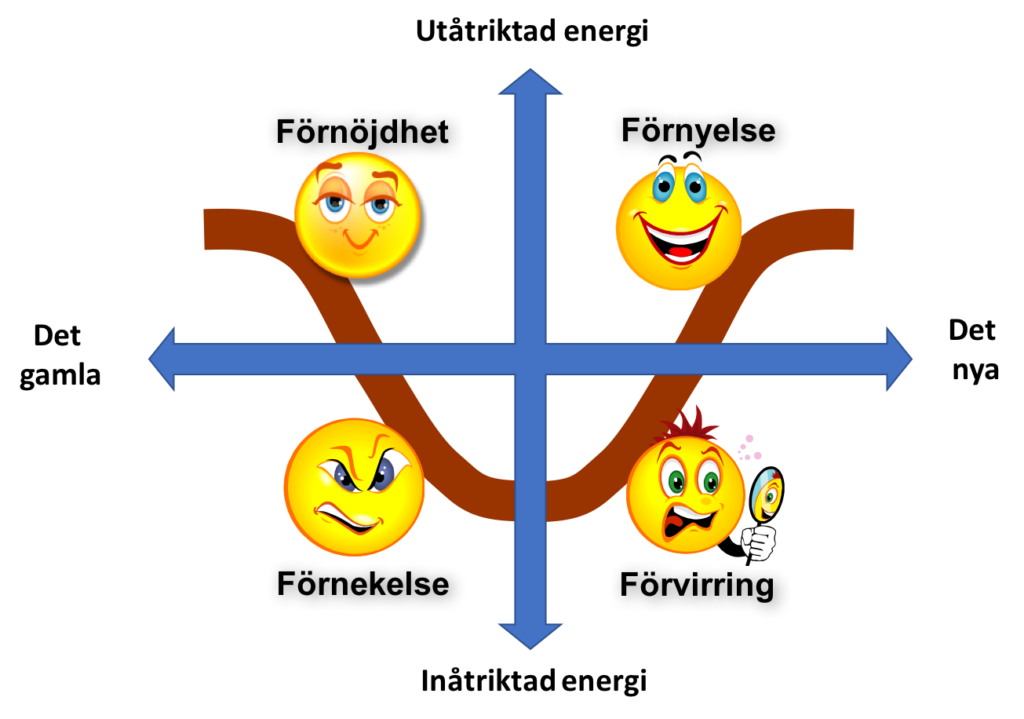
Claes Janssen’s model “The Four Rooms of Change”

(Source: Wikipedia)
The Four Rooms of Change — sometimes called “the Four-Room Apartment” — is a theory of how people and organisations react in crisis and development, under stress and external pressure. The theory is based on Claes Janssen’s research at Stockholm University, where he discovered a movement between four basic psychological states that all people seemed to pass through in shorter or longer cycles.

The four rooms are:

  • Contentment
  • Censorship/denial
  • Confusion and conflict
  • Inspiration/renewal

Contentment

In the room of contentment we feel good about the way things are. There is harmony, things work, and there is little reason to question the status quo. The problem is that this room holds no driving force for change either — and when change does arrive from outside, it is often met with resistance. “Things work just fine as they are!”

Censorship and denial

When contentment is disturbed, many people move into the room of denial. They minimise the problems, defend the old, and avoid confronting the need for change. Deep down they know something is wrong — but they do not admit it. It is a room with a high threshold to leave, and some people get stuck here for a long time.

Confusion and conflict

Once denial is broken through, you end up in a chaotic and turbulent room. Old truths are questioned, conflicts arise and emotions run high. It is uncomfortable — but also necessary. The old is being broken down and the new has not yet taken shape. Getting through this room is a prerequisite for real change.

Inspiration and renewal

On the other side of confusion awaits the room of renewal. Energy returns, new ideas are born and people are ready to embrace the new. It is a creative and hopeful room — but also one you have to earn by getting through the earlier phases.

Since 1993 the theory has been applied in working life through a range of diagnostic tools, such as the Organisation Barometer. IKEA has used the concept across the entire group since 1996. Janssen’s texts and educational tools have been translated into more than ten languages.

[Link: Wikipedia article on the Four Rooms of Change]
[Link: Website about the Four Rooms of Change]

A journey through the phases of change

Meet Jeanette — an ordinary nurse in healthcare: “There’s another change coming up… We’re supposed to start using something called Patient Records Online! What nonsense is that!”

With many thanks to Region Norrbotten, who made the film and gave their permission to share it. (The film is in Swedish.)

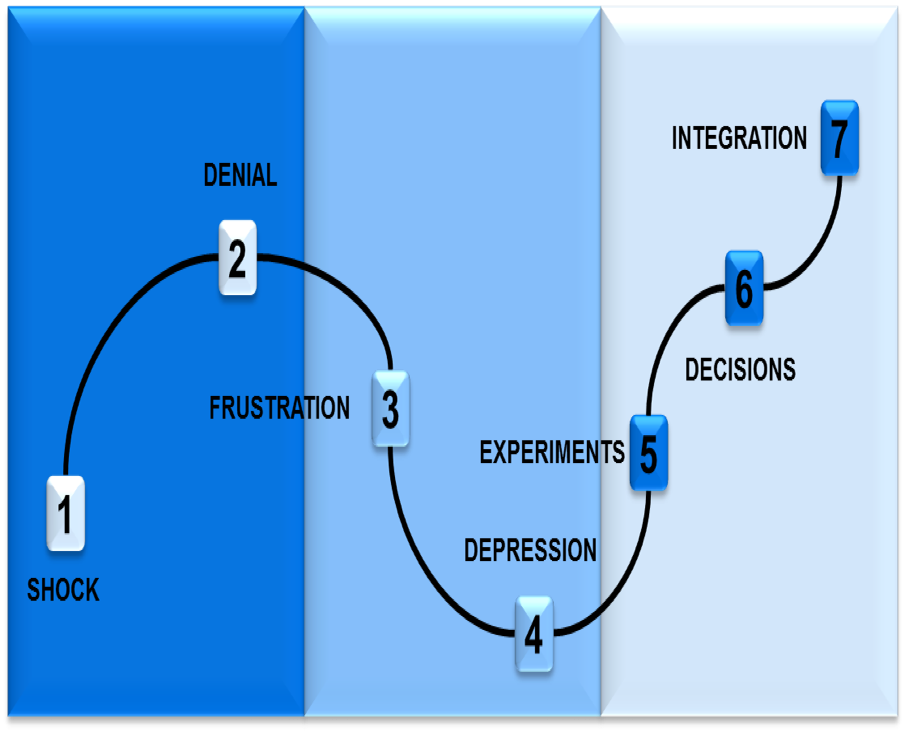
Kübler-Ross’s “grief curve”

(Source: Wikipedia)
The Kübler-Ross model — or the five stages of grief — was formulated by the psychiatrist Elisabeth Kübler-Ross in 1969 after working with terminally ill patients. The model has gained currency far beyond scientific contexts and is used today in discussions of many kinds of personal crises and changes.

The model describes how a person facing extreme and terrible fates will go through a series of emotional phases — and that most people jump back and forth between the phases and sometimes find themselves on several levels at once.

Denial

A conscious or unconscious refusal to accept reality. A defence mechanism that is usually temporary — but that some people get stuck in.

Anger

Strong anger breaks through the shock and denial. Anger can be directed at oneself, at others or at the circumstances. It is important to remain non-judgemental when relating to a person in this phase.

Bargaining

The individual bargains to postpone or delay the inevitable — often with a “higher power” in exchange for a reformed lifestyle. “I understand that it’s going to happen, but if I could just do something to buy myself more time…”

Depression

The person begins to become clearly aware of the inevitable and may become silent, withdrawn and grieving. Kübler-Ross recommends not trying to cheer someone up in this phase — it is an important and necessary time of processing.

Acceptance

The individual begins to come to terms with the situation. How long this stage lasts varies depending on the person’s situation — and the loved ones who are left behind often have to pass through their own individual stages of grief.

Kübler-Ross originally applied the model to the terminally ill, but later expanded it to several forms of severe personal loss — job, income, freedom, marriage. It is the individual who defines what counts as a serious tragedy.

[Link: Wikipedia article on the Kübler-Ross model]

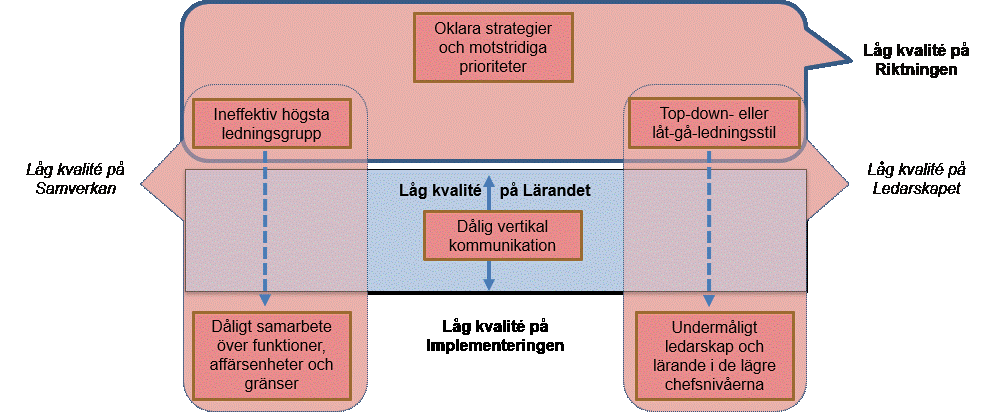
In the article “The Silent Killers of Strategy Implementation and Learning”, the researchers Michael Beer and Russell A. Eisenstat at MIT analysed a number of major companies that had failed to implement new, decided strategies.

The result is a list of six “silent” barriers that, without making much of a fuss, effectively block every attempt to implement new strategies. The barriers are grouped under three factors, all of which are needed to succeed with implementation.

1. Poor quality of direction

Top management’s ability to create an agreed, clear and attractive vision

An ineffective top management team

An ineffective management team creates no durable agreements and takes no responsibility for execution. An effective management team works together with a clear focus on what is best for the organisation — with trust and respect between its members and a mutual accountability for the decisions taken.

Unclear strategies and conflicting priorities

A management team whose members guard their turf rather than create good agreements does not have the tough conversations about prioritisation and reallocation. This leads to unclear strategies where everyone’s perspective is allowed to remain valid — and without clear priorities it is hard to achieve enough focus in the change work.

A laissez-faire or top-down leadership style

Poor follow-up and a lack of consequences when things go off track create a gap between management and the organisation. Any challenges in the implementation are not fed back upwards, which means the vision can come across as unrealistic — without management even knowing it.


2. Poor quality of learning

Poor learning leads to a lack of understanding and poor opportunities to adjust strategies if something unforeseen occurs

Poor vertical communication

If vertical communication does not work, two problems arise: the reasons behind management’s decisions do not reach the whole organisation — and the challenges that arise during implementation do not reach management. Without this feedback, management cannot learn, adjust and act.


3. Poor quality of implementation

Factors that affect the force behind the roll-out of the new vision

Poor coordination across functions and business units

When the managers on the management team do not work together, it is often mirrored further down — departments guard their turf, blame each other for problems, and are unused to solving the challenges that arise in the gaps between them. Strategies that require collaboration between units then become very hard to implement.

Insufficient leadership at the lower management levels

A laissez-faire leadership style or a top-down culture often creates a disengaged and overly operational leadership in the line organisation. Managers who focus on their daily operations do not contribute enough to the more long-term strategies — and the implementation loses momentum further down in the organisation.

If you discover that your own organisation suffers from one or more of these factors, that is still a step forward — there is a great deal to gain from actively working to eliminate them!

[See also the section “Stronger on implementation” under Plan]

[External link: The article can be ordered from Sloan Management Review]