tema 01 4 fördjupningar

Motivate

You can look at successful change work from at least two perspectives: what are the success factors for influencing people to enter a change, and how should you plan the change project to stand a better chance of succeeding?

This section focuses on the first perspective: what is needed to bring people along in change.

You can do a great deal to reduce resistance to change, but it is engagement with the change that will drive it forward! By building a high level of engagement for the change, you can more easily bring about the sacrifices that all change demands.

Many experienced change leaders and researchers have developed good ideas and explanatory models around engagement, useful in different contexts depending on the conditions of the change project.

What keys are needed to get people to enter a change? There are many answers to that question.

There are many lessons to draw from successful and failed change projects. One of the most important is to identify which success factors increase the chance of succeeding in the change work. Feel free to use the following as checklists when you start to approach implementation.

See also the “Plan” section and the “Choose” section on how to set up change work the right way in order to succeed


Success factors for change from New2change.com

What is “best practice” when it comes to creating successful change?

After reading countless articles on change management and trying out various strategies, I have boiled the success factors down to four — or six, if you count the sub-groups. And you should!
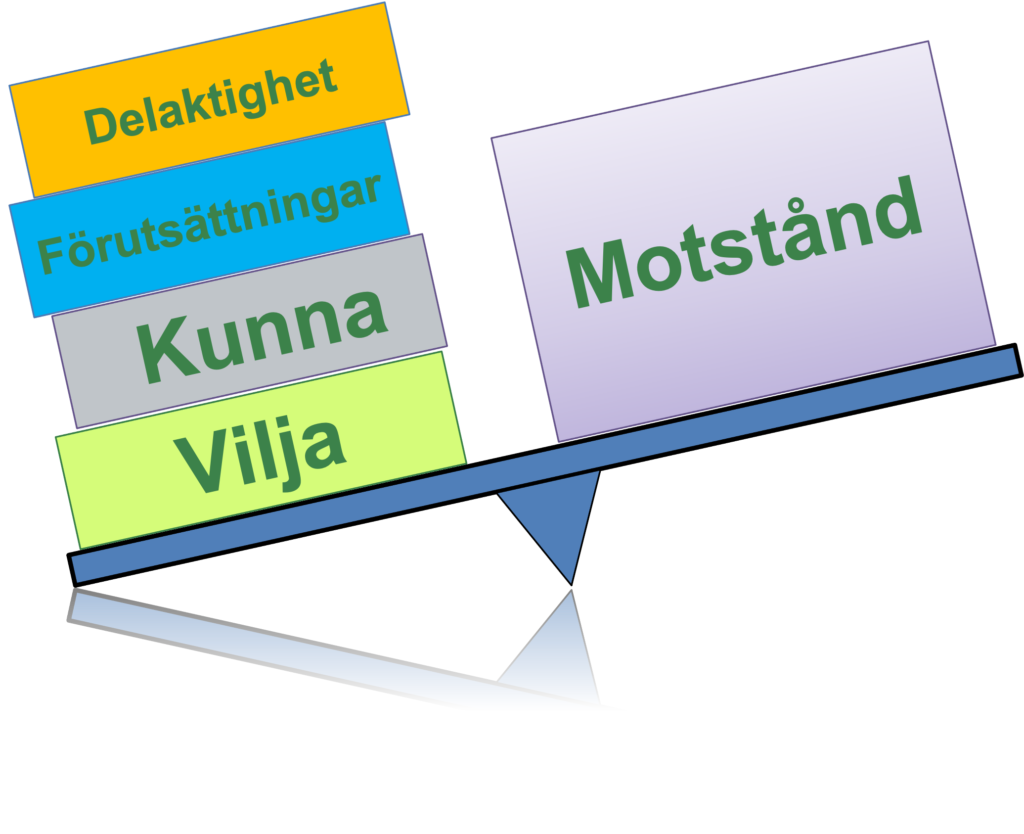
Based on the article “How to have influence”, I have translated the article’s six strategy groups into three overarching success factors: Will, Ability and Organisational conditions. With those success factors in place, the article predicts that you will succeed in a little over half (63%) of your change projects.

The fourth and most fundamental success factor is Involvement — genuinely involving managers and employees at a deep level produces better problem analyses, more firmly anchored improvement ideas and a greater sense of ownership in the execution.

To succeed with change, you therefore need strategies for the following six areas:

  • 1. Involvement — I am involved. Are managers and employees involved? Have we captured their perspectives and ideas, and thereby made them co-responsible for the change work?
  • 2a. Will — I am motivated. Have we created meaning around the change, worked with involvement and reinforced the positive emotions and initiatives?
  • 2b. Will — The manager is committed. Do managers encourage the will to change? Are the managers and the informal opinion-leaders committed and living by the new vision?
  • 3a. Ability — I can do it myself. Do employees have the right skills? Are we helping them develop knowledge, skills or personal qualities?
  • 3b. Ability — Others provide support. Do others contribute support when it is needed? Have we ensured access to the right resources, coaching and mentoring — especially when challenges arise?
  • 4. Organisational conditions. Is the “right” behaviour made easier and the “wrong” behaviour made harder in everyday work? Have we secured the organisational conditions through, for example, recurring feedback, customer feedback and benchmarking?

These are the components I always try to have a plan to achieve when I run my own change projects. My “go-to model”.


Success factors from the article “How to have influence”

Looking for “the strategy for successful change”? Forget it — the solution is several parallel strategies.

The authors Joseph Grenny, David Maxfield and Andrew Shimberg sort change strategies into six groups — three linked to motivation and three to ability and support. Their research shows that if you use several strategies in parallel, you are four times more likely to succeed.

One study showed that managers who used four or more parallel strategies succeeded in 63% of their change projects — while managers who relied on a single strategy succeeded in only 14% of cases.

The six strategy groups:

  1. Build personal motivation. Are the employees motivated? Create meaning around the change, connect it to fundamental values, reinforce positive emotions and initiatives.
  2. Build social motivation. Does the environment — especially the managers — encourage the right behaviour? Managers and informal leaders often have a greater influence on employees’ behaviour than peers do. Engage them and let them live by the new vision.
  3. Build structural motivation. Is the right behaviour rewarded? Structural motivation is about reward systems — pay, bonuses, recognition of special efforts and internal competitions.
  4. Build personal ability. Do the employees have the right skills? 77% of successful change projects included training as one of the strategies. Research shows that training spread out over a long period is more successful than a single concentrated effort.
  5. Build social support. Do others contribute support when it is needed? Coaching and mentoring conversations, answers to questions and access to the right resources — especially when challenges arise.
  6. Build structural support. Is the right behaviour made easier and the wrong behaviour made harder in everyday work? Keep employees oriented towards the goal through recurring feedback, customer feedback and benchmarking.

This model is so general, robust and simple to use that I always teach it to the managers and change leaders who are about to drive a major change.


A change formula from Beckhard/Harris

Can success factors for change be described in the form of a formula? Richard Beckhard and Reuben Harris thought so, describing their “change formula” as early as 1977 in the book Organizational Transitions: Managing Complex Change.
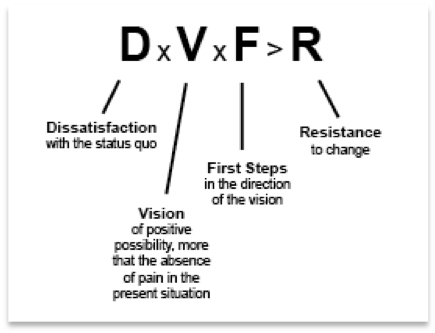
Beckhard and Harris’s formula:

D × V × F > R

The formula describes the necessary conditions for change:

  • D = Dissatisfaction with the current situation. Without dissatisfaction, few are motivated to change. Dissatisfaction can be any factor that makes people unhappy with the status quo.
  • V = Vision of positive possibilities. The proposed solution must be attractive and understandable. The more clearly you describe the goal, the more likely your team will want to come along.
  • F = First steps towards the vision. The team must be convinced that the change is realistic and achievable.
  • R = Resistance to change. This includes conviction about one’s shortcomings, stubbornness, inertia or a lack of interest.

Change will happen when the product of Dissatisfaction, Vision and First steps is greater than the Resistance to change. The relationship highlights that all three components must be in place at the same time in order to overcome the resistance.

I use this “formula” as a general reminder that the messages and communication must contain both a compelling reason why we must change, what the attractive target picture is and how we get there. Otherwise there are several reasons to resist.
“If the manager triggers threat signals, the employees simply cannot deliver. They have only one thing in focus — the tiger that is attacking them. They go into a state of stress and get tunnel vision.”
— Marie Ryd, science journalist and former researcher at Karolinska Institutet

From the discoveries of brain research about why we react the way we do, we can draw many lessons about what supports a change and what creates unnecessary resistance.

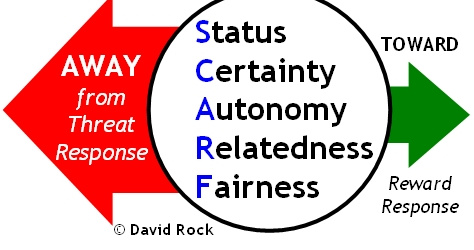
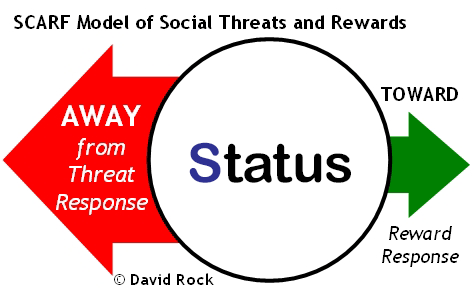
In 2008 David Rock presented the SCARF model — a model that summarises five social domains shown in studies to activate the same threat and reward systems as physical threats and real rewards.

  • Status — relative importance to others
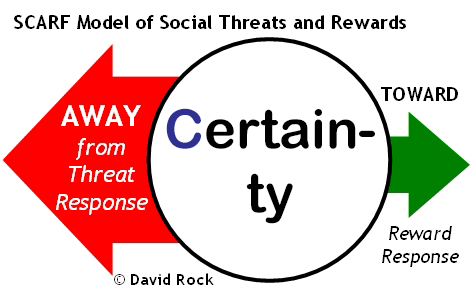
  • Certainty — being able to predict the future
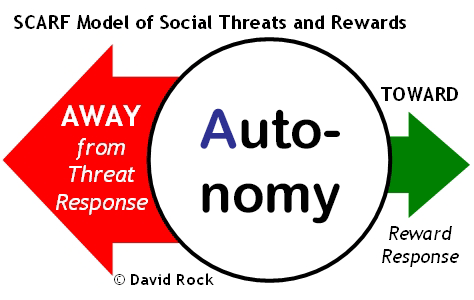
  • Autonomy — a sense of control over events
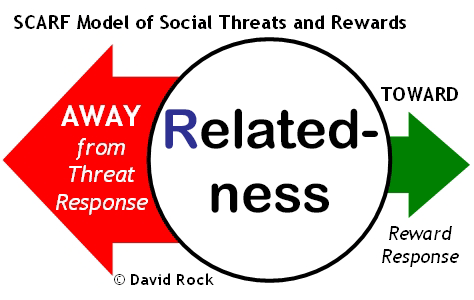
  • Relatedness — a sense of safety with others, that they are friends rather than foes
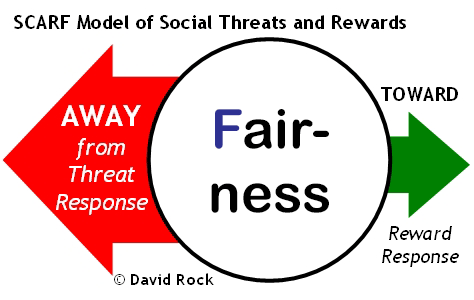
  • Fairness — a perception of fair exchanges between people

When we experience social threats, the brain reacts in the same way as when there is a lack of basic needs such as food, water or safety. The brain’s analytical and creative systems shut down — an important insight for anyone leading change.


David Rock’s lessons — a summary

1. Status

Status is about relative importance, “pecking order” and rank. The sense of status rises when you feel “better than” another — which activates the brain’s reward circuits. A perceived drop in status, on the other hand, can generate a strong threat response.

Resistance is activated when status decreases

  • In change where individuals may experience reduced status — for example by losing their place on the management team or having less opportunity to influence — you can expect more resistance.
  • It can be surprisingly easy to unintentionally threaten someone’s sense of status, for example through advice that is not perceived as warranted or hints of inefficiency.

Engagement is activated when status increases

  • People experience increased status when they feel they are developing and being recognised for their development.
  • Positive feedback — especially public recognition — can contribute to a sense of increased status.
  • Interestingly, an individual’s status can rise without implying reduced status for anyone else, for example by shifting the focus from quantity to quality.

2. Certainty

The brain is a pattern-recognition machine that constantly tries to predict what will happen next. Without predictability, the brain is forced to use far more resources to process each moment. The slightest uncertainty activates the threat systems and shifts attention towards whatever is perceived as wrong.

Resistance is activated by a lack of certainty

  • Greater uncertainty — such as not knowing what is expected or whether your job is at risk — can trigger powerful threat reactions.
  • When we feel that someone is not telling the whole truth or is acting inconsistently, it creates uncertainty. It is like the blinking printer icon when the paper has jammed — until it is resolved, it is hard to focus on anything else.

Increased certainty creates engagement

  • Clarify what is unclear or unspoken.
  • Break complex wholes down into smaller steps and clarify expectations.
  • Change management is to a large extent about increasing precisely this sense of certainty, in contexts where uncertainty is high.
  • Even in highly uncertain times, a clear message about when more information will come can be enough to increase the sense of certainty.

Change management is to a large extent about increasing precisely this sense of certainty, in contexts where uncertainty is high.


3. Autonomy

Autonomy is about independence and choice — the perception that you have control over your own situation. Unavoidable or uncontrollable stress can be extremely destructive, while the same stress experienced as a choice becomes considerably less destructive.

Resistance is activated when autonomy is threatened

  • Feeling forced into a change, experiencing a lack of control or feeling micromanaged can generate strong threat reactions.
  • Teamwork naturally leads to reduced autonomy — in healthy groups this is counterbalanced by increased status, certainty and relatedness, but with the autonomy threat just beneath the surface it is worth staying alert.

Engagement increases when autonomy increases

  • Involving people in change projects raises motivation and contributes to a sense of participation.
  • Let engagement-driven working groups work on different parts of the project.
  • The statement “Here are two options — which do you prefer?” generates stronger engagement than “Do this — now.”

Feeling forced into a change can generate strong threat reactions, while involving people in change projects can raise their motivation and contribute to a sense of participation. 


4. Relatedness

Relatedness is about determining whether someone is a friend or a foe — a judgement made quickly that affects how the brain functions. Information from people we perceive as “like us” is processed by the same circuits as our own thoughts, while we use other circuits for those perceived as different.

Resistance is activated when relatedness is threatened

  • The concept of relatedness is closely linked to trust. When someone does something untrustworthy, the most common reaction is to withdraw.
  • The need for safe human contact appears to be a primary drive, much like the need for food — deprived of safe social interaction, a threat response is awakened in the body.
  • Collaboration between people from different cultures who do not meet regularly can be particularly challenging.

Engagement increases when relatedness increases

  • The key is to find ways to increase safe connections between people.
  • Distrust of those you do not know can be softened through social encounters, informal video meetings or by sharing information about yourselves through stories and pictures.
  • Establish buddy systems, mentoring programmes or small groups for action learning — small groups consistently seem to be safer than large ones.

5. Fairness

Fair exchanges carry an inherent sense of reward, while unfair exchanges generate a powerful threat response. People who perceive others as unfair feel no empathy for their pain — in some cases, punishing unfair people can even generate a sense of reward.

Resistance is activated by a sense of unfairness

  • A lack of clear ground rules, expectations and goals can all lead to situations that are perceived as unfair.
  • A sense of unfairness easily triggers a threat response. Examples of how employees might perceive unfairness:
    • “He has different rules for Mike and Sally than for the rest of us.”
    • “Management says we have to make cuts, but the sales department doesn’t have to let anyone go.”
    • “There’s a lot of talk about values, but at the top they don’t practise what they preach.”

Engagement is built on a sense of fairness

  • The threat from perceived unfairness can be eased through greater transparency, communication and engagement.
  • Let working groups set their own rules. Establish clear expectations in all situations.
  • Interestingly, it is the perception of fairness that is the key — even a minimal pay cut for someone in a management position during a difficult time can strongly help reduce the sense of unfairness among employees.

I teach this model to management teams and managers facing major restructuring in the organisation. It gives a clear explanation of the strong reactions that can arise, and remedies for calming them down.

Here you can read David Rock’s original SCARF article


  • Anders Risling’s list of what builds engagement
  • Aaron Antonovsky’s three factors for creating engagement — Sense of Coherence (SOC)
  • John P. Kotter’s recommendation for change

You can do a great deal to reduce resistance to change, but it is engagement that will drive it forward. How do we motivate people in change and build engagement in individuals?

It is important to identify and handle the worry and resistance a change provokes — but the greater challenge perhaps lies in also building engagement for the new. By building a high level of engagement, you can more easily bring about the sacrifices that all change demands.

See also the “Plan” section and the “Choose” section on how to set up change work the right way in order to succeed


Anders Risling’s four factors for engagement

Anders Risling is a well-regarded organisational consultant with long experience of large-scale organisational change. In his research article “Designing a Community of Practice” he highlights that engagement and ownership are built by a willingness to fight for your cause when you feel that it is:

  • Compelling — you can genuinely understand it; it is intelligible and urgent.
  • Wise — you can see that it is rational and how it can be viewed from a larger perspective.
  • Attractive — you have a sense that it is valuable and that it is grounded in real anchoring and genuine values.
  • Pragmatic — you can see that you can use it to make your work more efficient and that it will lead to good results.

These four factors are necessary for us to feel fully engaged, according to Anders Risling.

I often use Anders Risling’s list to help formulate the message when introducing new IT systems


Aaron Antonovsky’s Sense of Coherence — three factors for engagement

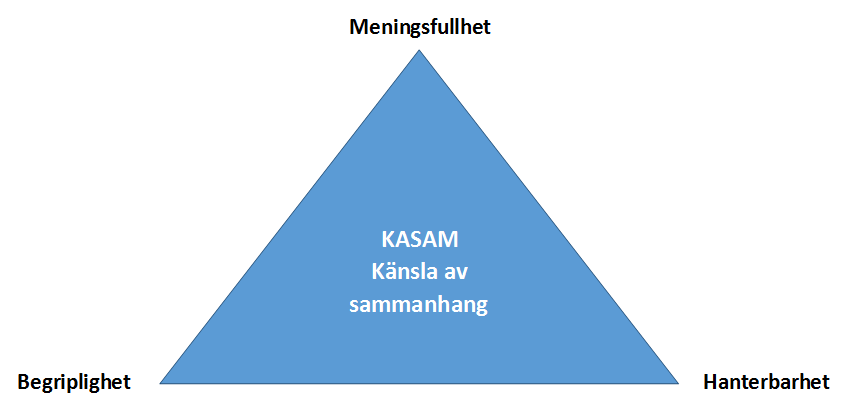
Sense of Coherence (SOC) is a concept coined by Aaron Antonovsky, professor of medical sociology at Ben Gurion University of the Negev. SOC consists of three parts: comprehensibility, manageability and meaningfulness.

Originally, SOC was about the idea that an individual can be in good health if they can feel part of a context that is understandable and meaningful. The model also works well to describe what is required for a person to want to enter a change:

  • Comprehensible — the change and its background can be understood.
  • Manageable — the necessary resources are available.
  • Meaningful — the change is carried out with participation.

I find that Aaron Antonovsky’s model gives a good understanding of the foundation that is important for bringing employees along on a change journey


John P. Kotter’s recommendation

A study by John P. Kotter, in which he analysed change projects at around a hundred larger companies, resulted in the book The Heart of Change.

He found that successful change work is more often about getting people to feel and act differently — rather than getting them to think in a new way.

Analyses create understanding…
Reports and presentations that demonstrate the seriousness of the current situation and point out new ways forward can persuade and create understanding. But — even if a convincing analysis can make employees understand what good development looks like, it is rarely analytical results that engage people and encourage them to man the barricades. And in times of major change, extraordinary engagement is needed from many people in the organisation.

…but “aha” moments create engagement
By creating striking situations that help the recipients form an emotionally charged picture of problems, solutions or success, you can reach people on a deeper level than a presentation of an analysis can. Emotional “aha” moments awaken engagement and spur new ideas that change behaviour.

Engagement for the new therefore comes more often through emotional “aha” moments than through logical analysis.

Some organisations suffer from every new strategy running into the sand, even though there seems to be no clear resistance to them…

Two researchers at MIT decided to look for the cause. 

In the article “The Silent Killers of Strategy Implementation and Learning”, Michael Beer and Russell A. Eisenstat analysed companies that had failed to implement new strategies. They identified six silent barriers and present strategies for counteracting them.

[Internal link: Read the detailed description of the silent barriers under Resistance]
[External link: The article can be ordered from Sloan Management Review]


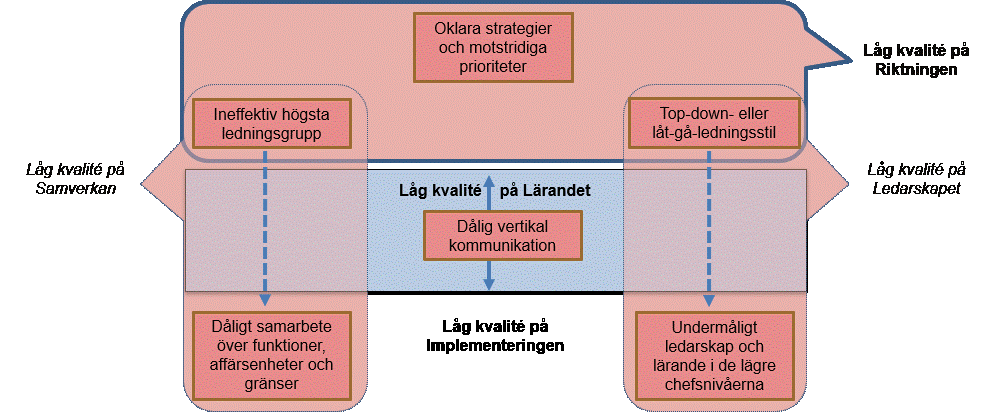
Six silent barriers that block implementation

1. Poor quality of direction

  • An ineffective management team — creates no durable agreements and takes no responsibility for execution.
  • Unclear strategies and conflicting priorities — when the management team guards its turf instead of having the tough prioritisation discussions.
  • A laissez-faire or top-down leadership style — builds up a gap between management and the rest of the organisation.

2. Poor quality of learning

  • Poor vertical communication — the reasons behind the strategies are not communicated downwards, and the challenges during implementation are not communicated upwards.

3. Poor quality of implementation

  • Poor coordination across functions and business units — slows down every strategy that requires coordination.
  • Insufficient leadership at the lower management levels — creates a disengaged and overly operational leadership in the line organisation.

If you discover that your own organisation suffers from one or more of these factors, that is a step forward — there is great potential in actively working to eliminate them.


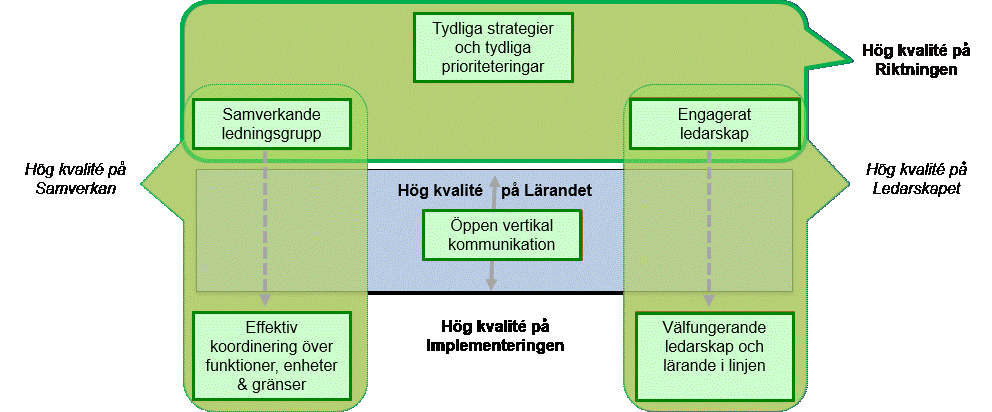
Six strategies that counteract the silent barriers

1. Increased quality of direction

  • An effective management team — a collaborative management team with a clear focus on what is best for the organisation, where the members feel trust and respect for one another and hold each other accountable for the decisions taken.
  • Clear strategies and clear priorities — an effective management team has the tough prioritisation discussions, which creates clearer agreements and the focus required for successful implementation.
  • Committed leadership in top management — regular dialogues with subordinate managers about vision and strategy, together with active follow-up and clear feedback, reduce the gap between management and the organisation and make it possible to adjust strategies when challenges arise.

2. Increased quality of learning

  • Well-functioning vertical communication — when communication works, the reasons behind the strategies reach the whole organisation, and challenges during implementation reach management, who can learn, adjust and act.

3. Increased quality of implementation

Active leadership and development at the lower management levels — committed leadership from the top creates better conditions in the line organisation. Leadership development and active strategic dialogues make it easier for line managers to contribute to the implementation of long-term strategies.

Active coordination across functions and business units — when the management team collaborates, the conditions improve for departments and units to do the same, which is crucial for strategies that require coordination.

I find this model invaluable for showing a management team what is needed for the organisation to become stronger on implementation — whether the desired change concerns embedding core values, executing new strategies or better dynamic governance in a changing world.