What is ADKAR?
Prosci’s ADKAR model describes the steps that individuals and groups need to take for a change to be successful. The model has had a major impact and has been used by two-thirds of the Fortune 100 companies.
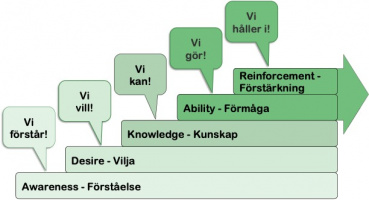
Seeing change as a process
Fundamental to the ADKAR model is the view that change happens as a process. The model makes clear how an individual moves through the change process — from unaware, via the insights required, to a successful change.
What makes ADKAR powerful is that it makes change visible as an individual journey — not a collective decision. An organisation does not change. The people who work in it, however, do. ADKAR helps leaders understand where in the process each individual is and what is needed to take the next step. The five steps should be seen as a staircase, where each step needs to be achieved before moving on to the next. The five steps are:
- Awareness — awareness of the need for change
- Desire — the desire to change
- Knowledge — the knowledge to perform optimally in the desired state
- Ability — the ability (time, tools etc.) to perform in the desired state
- Reinforcement — anchoring of the desired state to counteract regression
The five steps in ADKAR
Step 1 — Awareness: Awareness of the need for change
Before anyone can change, they must understand why the change is necessary. What happens if we don’t change? What is the risk of standing still? The leader needs to communicate clearly and repeat the message — in different ways and in different contexts.
Step 2 — Desire: A desire to support the change
To understand why is not the same as to want to change. It is about motivation — and motivation is deeply personal. What does the individual employee gain from changing? How does it affect their everyday work, their role, their future? The leader needs to listen and meet the individual where they are.
Missing the insight into why the change must be made? Put your focus on redoing step 1.
Step 3 — Knowledge: Knowledge of how you need to change
Once the will is there, knowledge is needed — about what is to be done differently and how. It is about education, training and clear instructions. Without the right knowledge, the change stalls, no matter how motivated the person is.
Struggling to get managers and employees to attend the training? Make sure to build motivation by doing step 2 more thoroughly.
Step 4 — Ability: The ability to act in the new
Knowledge is not enough either. To know how to do something is not the same as being able to do it in practice. It takes practice, support and room to make mistakes. The leader needs to create the conditions for new behaviours to become established.
Step 5 — Reinforcement: Reinforcement for long-term sustainability
The final and often most neglected phase. Without reinforcement, we slide back into old patterns. Positive feedback, visible progress and consistency are what make the change permanent.