Several researchers have described the emotional roller-coaster a person goes through during crises or major change. One of the most widely known is Claes Janssen’s “Four Rooms of Change”.
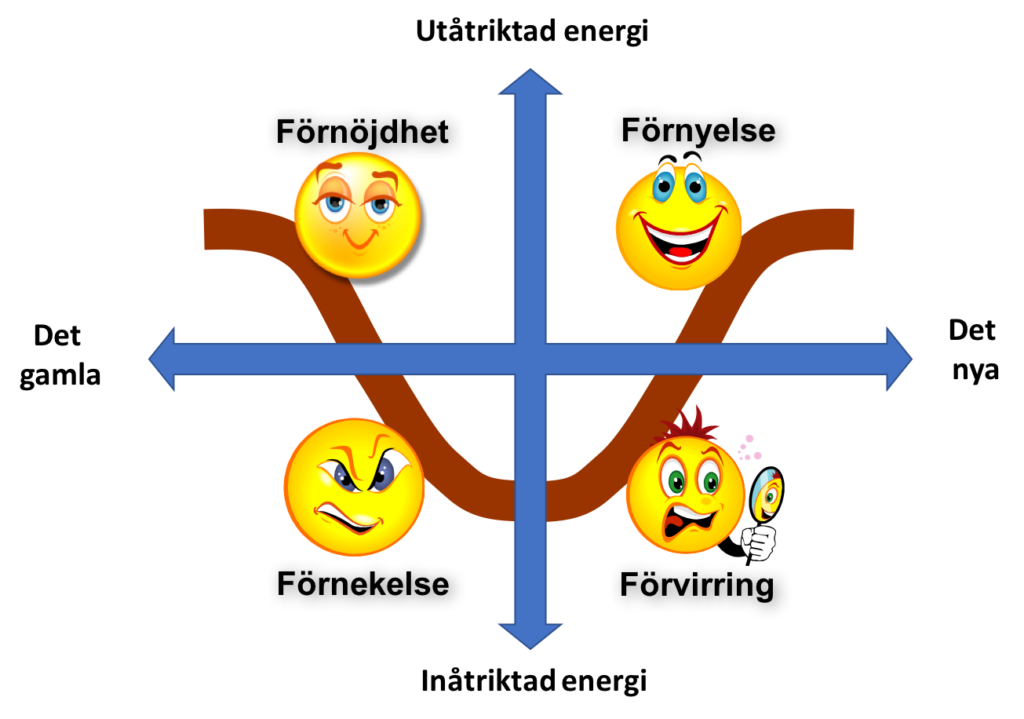
Beyond describing the different phases of an individual’s change journey, there is a complete set of working materials for teams, where the group is helped to make visible what happens during a change and together develop a way forward based on the group’s needs.
About the Four Rooms of Change
Source: Wikipedia
The Four Rooms of Change (sometimes called “the Four-Room Apartment”) is a theory of change. It is used to analyse how people and organisations react in crisis and development, under stress and external pressure.
The theory of the Four Rooms of Change is based on Claes Janssen’s research at Stockholm University.
The core of the theory is a four-part model, the “Four-Room Apartment”, which shows how an individual or a group travels through different stages in a change process.
The four parts are:
- contentment
- censorship/denial
- confusion and conflict
- inspiration/renewal.
Since 1993 the theory has been applied in working life through a range of diagnostic tools, for example the Organisation Barometer. Since 1996 IKEA has used the concept across the entire group. Over time, the Four Rooms of Change has also spread into areas such as schools and sport.
[Link: the Wikipedia article on the Four Rooms of Change]
About the Four Rooms of Change concept
Source: forandringensfyrarum.se
What is the Four Rooms of Change?
The Four Rooms of Change – or the Four-Room Apartment as it is also called – is a complete concept of methods, analysis instruments and models that work for innovation, development and change.
The Four Rooms of Change has its origins in the research that Claes Janssen carried out during the 1960s and 1970s, which shows how an individual or a group travels through different states in change processes. The Four-Room Apartment also shows how we as individuals experience reality completely differently, and how these differences can hinder or favour collaboration, change and development.
Based on Claes Janssen’s research findings, Claes and A&L Partners AB developed a range of practical and user-friendly analysis instruments, models and tools that are used with great success by both individuals and groups – and not least in business development.
Since the 1990s, the Four Rooms of Change has been applied in companies, the public sector and non-profit organisations. Today, hundreds of thousands of people around the world have gained help and insights through the Four-Room Apartment.
The certification programme ensures the quality and value of the practical application of the Four-Room Apartment.
Read more about the Four Rooms of Change
- The Four Rooms of Change as a theory (in Swedish)
- The models in the Four Rooms of Change (in Swedish)
- The history of the Four-Room Apartment (in Swedish)
- The Four-Room Apartment in the world (in Swedish)
- Trademarks and rights (in Swedish)
- Quality assurance (in Swedish)
- Criticism of the Four Rooms of Change (in Swedish)
Förändringens fyra rum® (the Four Rooms of Change®) is a registered trademark in Sweden and in large parts of the world. This means that only certified users may use the various trademarks as well as the texts, concepts, analysis instruments, models and tools developed within the framework of the theory.
[Link: the website for the Four Rooms of Change]
When does the model fit?
Suitable for:
- Change where involvement, shared processing and anchoring among all managers and employees is important and is allowed to take time
Less suitable for:
- Roll-outs of new IT systems or ways of working where the opportunity to influence is small
- Change where there is no time for involvement and processing
- Rationalisation projects — cuts often stir up strong emotions that make involvement work harder
Keep in mind:
- Before implementation, the change project’s platform needs to be developed
- After implementation, new ways of working, roles and processes should be incorporated into existing governing documents