There is no shortage of recognised, good strategies and models for leading change and development. Why are there so many? To a large extent it is because different types of change require different processes — but just as often, the change leader’s background and view of what change is matters just as much for how they describe their change process.
What follows is an overview of three highly useful change strategies that I have used as the backbone of various larger change projects, together with a few selected models and tools that are genuinely useful for involving people in, or “selling in”, a change.
To get help choosing the right strategy and/or model/tool for your particular larger change project, I recommend the Choose section, where I propose a method for analysing your project and then getting help to choose the right strategy/model/tool.
Since 1998, Prosci has carried out extensive studies within change management with more than 4,500 participants. As a result of this research, they have both developed and launched globally:
The PCT framework – Prosci’s three-step change strategy – with a wealth of models and tools for analysing, structuring and executing a larger change project
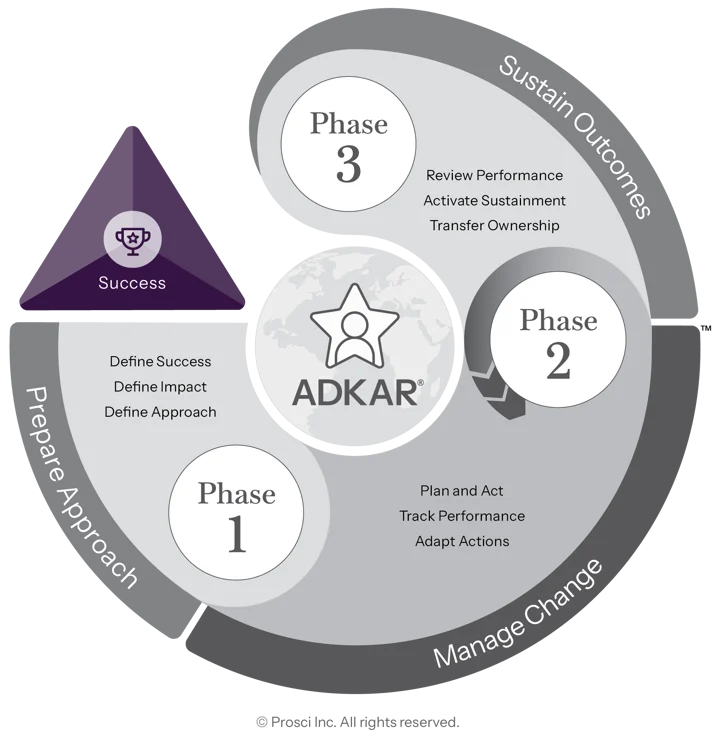
The ADKAR model — a model that summarises the steps an individual passes through on the way to lasting change, but which can also be applied to groups and to the different phases of a change effort.
The most important parts of the Prosci methodology
The Prosci methodology is one of the most widely used change management methods in the world, and it continues to evolve. In response to feedback from practitioners and changing client needs — and to prepare for future trends in change — we updated the methodology in 2021. The updated Prosci methodology is more action-oriented and accessible, and we believe the improvements will lift our clients’ success in an outstanding way.
Although the Prosci methodology encompasses a wide range of models, tools, assessments, processes and more, today it consists of three main components:
The PCT model – a simple but powerful framework for establishing and connecting the most important aspects of any successful change effort
The ADKAR model – a highly effective model for guiding individuals through the experiences — or elements — needed to bring about the change
The Prosci 3-Phase Process – a structured, flexible framework for driving change at the organisational level
I always use ADKAR as essential foundational knowledge within change management. Every manager needs to understand the right order of things, so that they don’t forget to create understanding and motivation before it is time for the training.
The follow-up The Heart of Change confirms the strength of the eight steps and shows that successful change work is more about getting people to feel and act differently — rather than to think in a new way. Engagement for the new comes through emotional “aha” moments rather than logical analysis.
Kotter’s 8 steps for change — a vivid description
For those of you who would like a vivid description of John P. Kotter’s eight steps for successful change work, here is a 20-minute lecture I gave at Förändringsledningsdagen (the Change Management Day), organised by Kvalitetsmagasinet and VD-tidningen. (The lecture is in Swedish.)
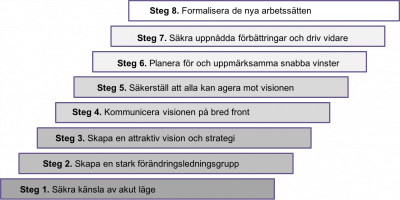
Kotter’s 8 steps for change — a short summary
Create the right conditions
Step 1 — Increase the sense of urgency
Many change projects are stillborn in an environment of complacent employees. Without an understanding that the change is necessary, the attention and the sacrifices needed will not be made. Step one is to increase the sense of approaching danger — that change from the present is necessary and urgent.
Step 2 — Build a strong guiding team
Without a strong leadership team with the right mix of competence and power, the change project will struggle to maintain the pace and scope of the change. The leadership team must also build a group-level trust that allows tensions to be discussed openly and honestly.
Missing a powerful leadership team? Put your focus on redoing step 1.
Step 3 — Build the right vision
The vision of the new must be emotionally attractive, challenge people towards transformative change and at the same time be properly thought through. Developing such a vision requires open and honest discussion within the management team and a focus on what is best for all stakeholders.
Struggling to find the vision? Make sure to build trust by doing step 2 more thoroughly.
Engage the whole organisation
Step 4 — Communicate broadly for buy-in
Many companies that failed with change projects under-communicated the vision by a factor of 10 or 100 — a good vision easily drowns in the flood of information that is everyday life in most organisations. Step four is about successful and far-reaching communication, and the hugely important task of “walking the talk” — making sure that decisions and actions from management do not run counter to the vision being communicated.
Step 5 — Empower people to act
There are often obstacles in the existing organisation to realising the new vision — old structures or mindsets that prevent employees from acting towards the new vision. The aim is to transform obstacles into support as people are encouraged to act in new, better ways.
Step 6 — Create short-term wins
Planning for short-term wins must start early. Wins within 12–18 months, and then 6–12 months later, give a sense of reward, spur fresh effort and keep the cynics in check.
Drive on and anchor
Step 7 — Hold the course and keep driving
Once a major step has been passed, there is a great risk of celebrating the partial victory too much — the effect can be that everyone exhales and the pace of change drops dramatically. Instead, the key is to use the momentum of the partial victory to launch new, even bigger changes.
Step 8 — Anchor the changes
For the behavioural change to become lasting, the change needs to be anchored in the company’s culture — something that is hard, but with the right focus clearly achievable.
For me, Kotter is the foundational model I return to most. Not to follow as a linear plan, but to make visible all the important components for succeeding with large-scale change: bringing leadership along, building an attractive vision, the crucial role of managers in monitoring and supporting the change at the local level, the value of drawing energy from “quick wins” and celebrating what we have achieved so far at half-time, and finally the importance of anchoring the new in standard documents and routines. It is simply a valuable checklist for the management team and the change project manager!
When I worked at INDEA — a senior organisational consultancy in Stockholm — and started using Kotter’s model, we discovered early on that it does not fully take into account the cultural differences between the USA and Sweden. The consequence, in our view, is that Kotter underestimates Swedish employees’ need to be involved in the change process.
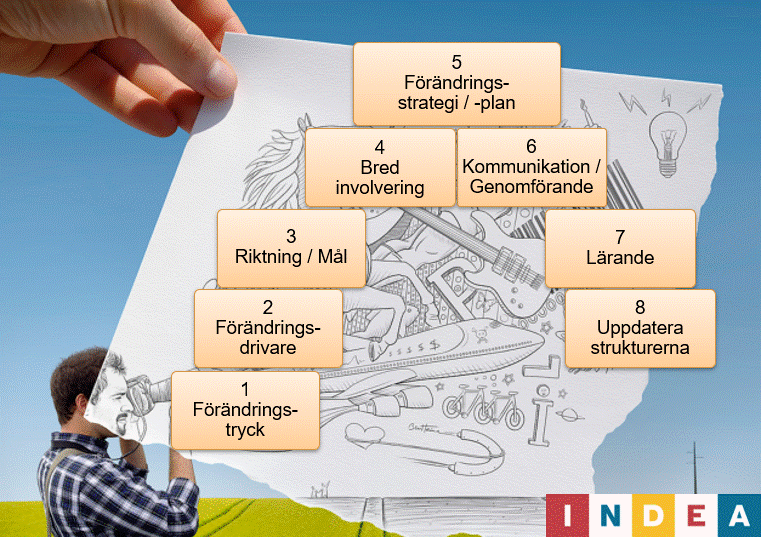
INDEA’s CEO Thomas Krook and I therefore adapted Kotter’s model to Swedish organisational culture. During my time at INDEA we were able to confirm, across a number of change projects, that the modified model really does work for Swedish conditions.
We are convinced that genuine involvement of managers and employees is a prerequisite for good decisions in the change project — and for managers and employees to take on responsibility for carrying out the change.
Build the change project’s platform
Step 1 — Make the compelling reason for change visible
To create an understanding of the necessity of the upcoming change, it is important to put great effort into analysing, describing and communicating the reasons why change is needed. We have been able to confirm across a number of change projects that the communication of carefully described reasons for change may be the single most important part of a change project.
Step 2 — Identify and activate change drivers
The next step is to identify the leaders and employees who are expected to take on responsibility for driving the change process. The group of change drivers needs to stay one step ahead of the rest of the organisation and must have a strong consensus around their roles in the process.
Step 3 — Define the direction of development and the goal
Creating energy in the change work requires a clear direction — formulated as a vision, a goal or a strategy. The most important thing is that it clearly shows where the organisation needs to move, and that the status quo is not an option.
Engage the whole organisation
Step 4 — Broad involvement
Once the reason for change, the current situation and the goal have been communicated, it is time to involve employees in working on HOW the new should look. Important target groups are partly the employees who have knowledge within the areas of the change, and partly those who will be affected by it.
Step 5 — Formulate the change strategy and change plan
Based on the employees’ contributions, it becomes management’s task to create a clear change strategy — what is to happen, and in what order?
Step 6 — Communication and action
With the strategy as a starting point, relevant development projects are formed in the organisation. Management leads and coordinates the work of communicating and implementing the project groups’ results. In this phase it is important to clearly demonstrate quick wins from the new way of working — in order to motivate as many people as possible to start working in the new way.
Drive on and anchor
Step 7 — Evaluation, learning and continuous improvement
Once a major step has been passed, it is valuable to acknowledge the progress, evaluate the solutions and decide what should be cemented and what should be developed further in the next wave of improvement.
To fine-tune and further develop the new business processes, a system for continuous learning is needed — one that makes the effects of the new way of working visible and provides knowledge about what works more or less well. Our experience is that many of Toyota’s lean tools, such as visual management and improvement meetings, are an effective way to secure the desired effects of the change process.
Step 8 — Cement the important changes
For the attitude and behaviour changes that have been made to become lasting, the change needs to be anchored in the company’s culture — long after the CEO and management team have moved on.
In truth, INDEA’s model for involving change is the model I would most like to use. It builds a sense of ownership that no other model does, and through involvement we have a much greater chance of arriving at the final solutions that genuinely become value-creating and well-functioning in everyday work! The problem is that few large-scale changes have that level of co-creation — instead, there is often a clear target picture developed by management that is not open to negotiation. But by working with a high degree of involvement around how we reach the final goal, the INDEA model is useful in more change projects.
I have worked for many years supporting and driving change projects with a high degree of involvement, and seen the power that comes from it. I have always worked in a needs-adapted way and in co-creation with the client’s steering group, using different methods and processes for involvement and implementation.
Below I list a few of the methods I return to — or that have a strong effect on people’s attitude to, and engagement in, the change project.
The Four Rooms of Change — Claes Janssen
In his model, Claes Janssen describes the different phases individuals go through during change. By letting all affected managers and employees work with the model as a basis, you identify what each group needs in order to move towards the new.
Marvin Weisbord and Sandra Janoff’s method lets several stakeholder groups work together over 2.5 days to find “common ground” — what everyone can get behind when it comes to the change being worked on.
The large-group conference Real Time Strategic Change
A large-group conference method for processing and fine-tuning a proposed vision or strategy from the management team into a finished final proposal, with a high degree of involvement.
Prosci’s ADKAR model describes the journey an individual needs to go through for a change to happen. It is an excellent fit for the implementation step.